

Whānau Māori experiences of alternative housing pathways reveal both the resilience of collective solutions and the structural injustices embedded in Aotearoa’s housing system.
Affordable Alternative Housing Tenure Pathways: Whānau Māori Experiences
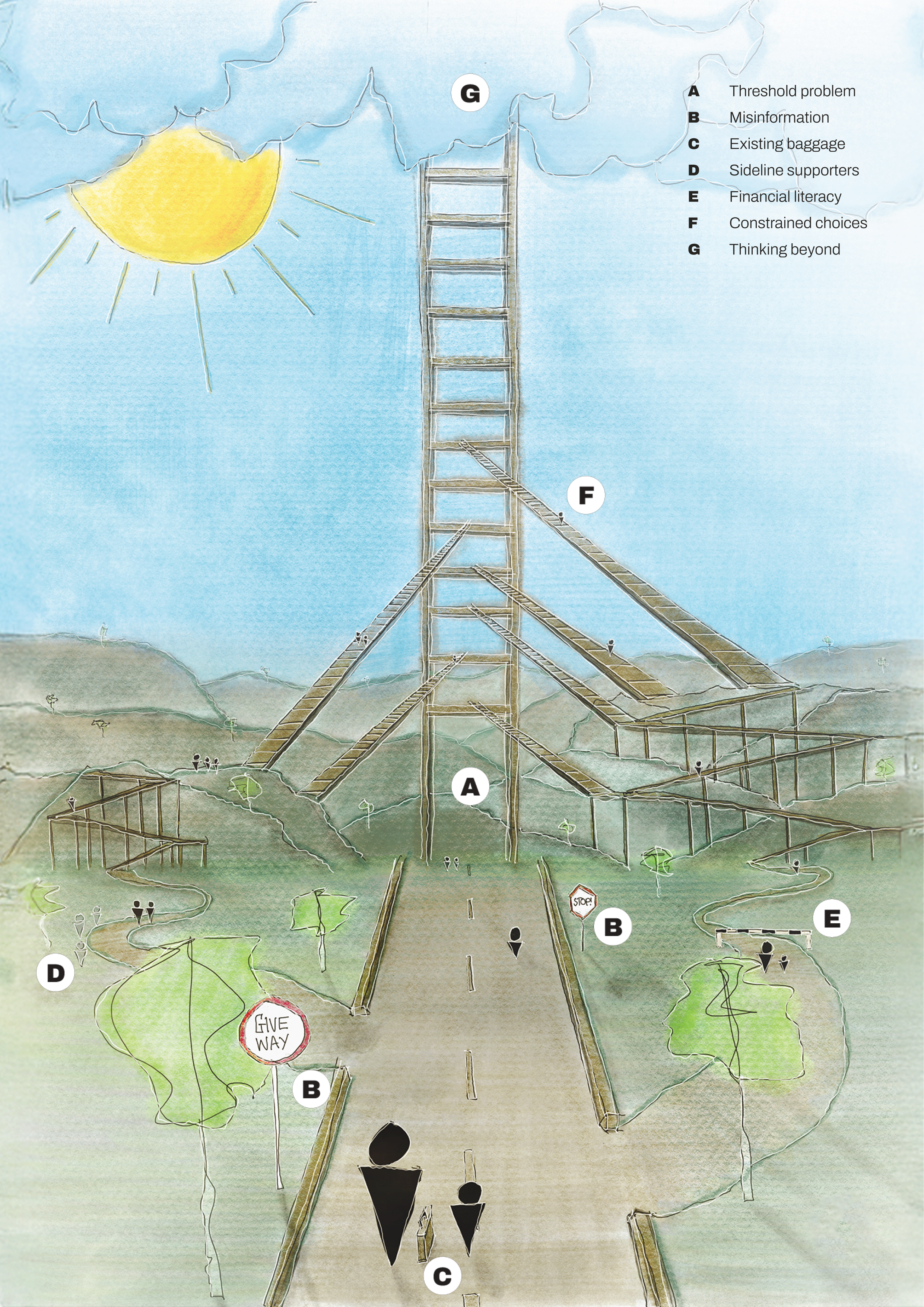
Illustration showcasing constraints found from research in regard to participants reaching the ‘property ladder’. Illustration by Ben Siesicki.
KAUPAPA (PURPOSE):
This research explores how whānau Māori experience alternative housing tenure pathways, such as shared equity, rent-to-buy and co-ownership, and what these journeys reveal about housing, wellbeing and mana motuhake.
PROJECT DESCRIPTION:
Home ownership in Aotearoa has become increasingly unattainable, particularly for Māori, who continue to experience the intergenerational effects of land dispossession, exclusionary finance systems and widening affordability gaps. In this context, alternative housing tenure pathways—including shared equity, rent-to-buy, iwi-supported loans and whānau co-ownership—have emerged as mechanisms for addressing the “threshold problem” of entering the housing market.
This research centres the lived experiences of seven whānau Māori who accessed home ownership through formal and informal alternative pathways. Using semi-structured interviews informed by kaupapa Māori principles, the project examines not only the financial mechanisms involved but also the relational, cultural and structural conditions shaping whānau housing journeys.
The findings reveal seven interconnected themes. Whānau encounter misinformation about eligibility and financial readiness; intergenerational transfers of wealth, knowledge and trauma shape confidence and aspiration; and trusted “sideline supporters”, such as mortgage brokers, housing navigators and whānau champions, play pivotal roles in building belief and countering institutional barriers. Financial literacy programmes can transform relationships with money and intergenerational planning, although alternative pathways may also involve constrained locations, contractual limitations and reduced flexibility.
At the same time, home ownership can unlock wider benefits, including greater housing stability, improved health, stronger cultural connection, increased participation in iwi life and the ability to plan for future generations.
Two case studies position these experiences within a wider landscape of Māori-led housing innovation. Ngāti Whātua Ōrākei’s Kāinga Tuatahi demonstrates how long-term leasehold arrangements can retain whenua in collective ownership while enabling whānau to own their homes. He Korowai Trust in Kaitaia illustrates how rent-to-own pathways can be combined with intensive wraparound support and social covenants for very low-income whānau.
The research argues that alternative tenure pathways should not be understood solely as innovative products within an otherwise functioning market. They are also pragmatic responses to systemic exclusion. From a spatial justice perspective, the challenge is both to expand these pathways and to transform the wider housing system by embedding collective ownership, Māori governance and intergenerational wellbeing at its centre.
PROJECT DETAILS:
TYPE OF PROJECT:
Research project.
PROJECT LEAD:
Dr James Berghan.
TEAM MEMBERS:
Els Russell, Ben Siesicki.
PEOPLE INVOLVED:
Seven whānau Māori homeowners participating in alternative tenure pathways; Māori housing providers, iwi organisations and Māori-led housing developers approached during recruitment
LOCATION:
Aotearoa - interviews in Tāmaki Makaurau, Kirikiriroa and Ōtautahi; case studies in Ōrākei and Kaitaia
PARTNERS / ORGANISATIONS:
Te Manawahoukura - Te Wānanga o Aotearoa.
FUNDER:
BRANZ, through the Building Research Levy.
PROJECT DATES:
2024 - 2026.
LINK: